July 8, 2026
Software is changing shape in the agentic era.
The model is only part of it.
Models are the engine. Agents are the application. Context is operational memory. Permissions are the firewall. Instructions are configuration. Evals are QA. Workflows are the backend. Trust is the bottleneck.
But one shift still gets underrated.
The new UI is not another app.
It is WhatsApp, Telegram, Discord, Slack, email, voice notes, forwarded files, internal chats, and the places where work already happens.
The old deal
For twenty years, business software made a deal with companies:
Buy the system, then make your people use it.
Companies bought CRMs, ERPs, helpdesks, dashboards, project management tools, analytics platforms, internal portals, workflow systems, knowledge bases, and ticketing platforms.
Then the real battle started.
Log in. Enter the data. Update the status. Move the card. Open the ticket. Complete the form. Attach the file. Check the dashboard. Tag the person. Close the loop.
Sometimes this worked.
Often it did not.
The software was installed. The work kept happening somewhere else.
Sales in WhatsApp. Support in email. Urgencies on phone calls. Decisions in meetings. Context in people’s heads. Files in whatever folder someone remembered. Follow-ups in personal notes. Approvals in chat threads.
The system of record was late because the system of action was elsewhere.
That is how a CRM becomes a museum.
Not because the company hates software.
Because the software asks people to leave the work in order to document the work.
The direction is reversing
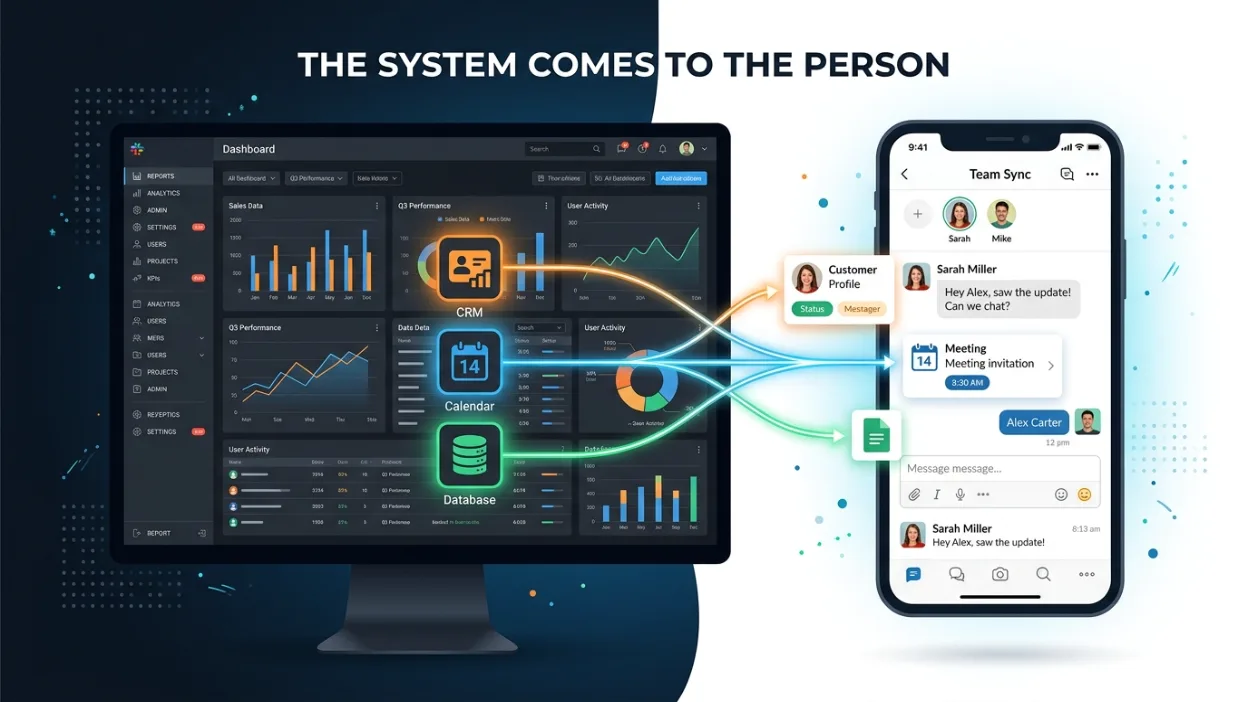
Agentic software flips the assumption.
Old:
The person goes to the software.
New:
The software comes to the person.
A salesperson sends a voice note after a call, and the system updates the CRM.
A customer writes through WhatsApp, and an agent classifies the request, checks context, responds if allowed, or escalates to a human.
A team works in Slack, and the operational system coordinates tasks, reminders, approvals, documents, and reports behind the scenes.
A founder asks, “What happened this week?” and gets an answer about what changed, what is stuck, what needs a decision, and what should happen next.
Not another dashboard.
An answer.
This does not mean everything becomes chat
Every interface becoming conversational is the lazy version of this argument.
I do not buy it.
Finance needs tables. Scheduling needs calendars. Inventory needs structured views. Complex configuration needs forms. Audits need logs. Analytics sometimes need charts. High-risk actions need explicit confirmation.
Screens do not disappear.
They stop being the mandatory entry point for every operational action.
A lot of business work begins as messy human communication: a message, a voice note, a forwarded email, a PDF, a screenshot, a customer complaint, a quick approval, a field update, a question in a team channel.
Traditional software asks humans to translate that mess into structured input manually.
Agentic software can do part of that translation.
The user should not have to become a data-entry clerk for the system.
The system should become an operational assistant around the user.
The real interface is the workflow
When people say UI, they usually mean screens.
Inside a business, the real interface is the workflow.
How does work enter?
How is it understood?
Who owns it?
What context is attached?
What action is allowed?
What needs approval?
What gets logged?
What happens if nobody responds?
What becomes visible to the next person?
A chat message alone is not a system.
A WhatsApp bot alone is not a system.
An agent inside Slack alone is not a system.
The system is the layer behind the channel: context, permissions, workflows, integrations, memory, review.
“AI chatbot for your business” is weak framing.
The chatbot is the visible edge.
The operating layer underneath is the valuable part.
Why this matters for adoption
People resist software when software asks them to do unnatural work.
A salesperson does not want to maintain the CRM. They want to sell.
A doctor does not want to manage appointment logistics. They want the patient to arrive prepared, at the right time, with the right information.
A support team does not want to check five platforms. They want requests classified, routed, answered, and escalated correctly.
An owner does not want another dashboard. They want to know what is happening before something breaks.
When the system appears in the natural flow of work, adoption changes.
The software stops demanding attention for its own sake.
It starts reducing the amount of translation the business has to do.
That is the adoption unlock.
Not prettier screens.
Less forced movement between work and system.
Trust becomes the bottleneck
It is easy to imagine agents everywhere.
It is harder to make them trustworthy.
A system that acts through WhatsApp, Slack, Telegram, or email is closer to the real world than a dashboard. It can message customers, update records, trigger workflows, create consequences, and create confusion if boundaries are weak.
The interface may get simpler for the user.
The backend gets more serious.
Can the agent see the right context? Avoid seeing the wrong context? Explain why it did something? Ask for approval when needed? Recover from ambiguity? Escalate instead of hallucinating? Get audited later? Respect permissions? Avoid leaking private information?
Permissions, evals, logs, and escalation paths are what make conversational operations safe.
Not bureaucracy for its own sake.
Trust infrastructure.
The opportunity is not AI glued onto old software
A lot of companies will take old software and add an AI panel.
Ask your CRM a question.
Ask your dashboard a question.
Ask your helpdesk a question.
Ask your documents a question.
Useful.
Limited.
The bigger opportunity is redesigning operations around agents, context, permissions, workflows, memory, evals, and natural channels.
That does not mean replacing every SaaS tool.
The CRM still exists. The calendar still exists. The drive still exists. The helpdesk still exists. The database still exists.
The difference is that humans no longer have to stitch them together through screens all day.
The agentic layer does the stitching.
A better question than “which AI tool?”
Old question:
Which software should we use?
Shallow current question:
Which AI tool should we use?
Better question:
Which parts of the operation should stop depending on a screen?
That points to the actual friction:
- data entry after calls;
- follow-up reminders;
- routing requests;
- extracting information from documents;
- answering common questions;
- preparing reports;
- checking what changed;
- escalating exceptions;
- capturing decisions;
- updating systems of record from natural communication.
These are operational design problems wearing a UI costume.
What comes next
The next wave of business software will not be only SaaS with AI attached.
It will be an operating layer made of agents, context, permissions, integrations, workflows, and conversational channels.
Less “go open the system.”
More “the system is already in the work.”
Less screen-hunting. Less manual translation. Less dashboard theater.
More software working quietly in the background.
The new UI is not an app.
It is the place where the work was already happening.
I design systems that let companies operate across the channels their teams already use: WhatsApp, email, Slack, Telegram, CRMs, spreadsheets, documents, and AI agents. If your software is installed but the work keeps happening somewhere else, contact me.
You can also email me at nicolasdominici@outlook.com or DM me on LinkedIn.