July 8, 2026
Most companies do not have a lead problem.
They have a follow-up problem pretending to be a lead problem.
Leads arrive. Someone replies. Maybe. A call happens. Maybe. A quote gets sent. Maybe. Then the opportunity drifts into WhatsApp history, a personal inbox, a spreadsheet, a CRM stage nobody trusts, or the memory of the one person who “knows what is going on.”
A month later, the owner says:
We need more leads.
Maybe.
But first, the company needs to stop wasting the ones it already has.
That is not solved by one automation.
It is solved by a follow-up system.
The bad version
The bad version is easy to build.
When a form is submitted, send an email.
When a deal is created, create a reminder.
When a lead enters WhatsApp, auto-reply with a template.
When a stage changes, notify someone.
All of that can be useful.
None of it is enough.
Because the problem is not one missing notification.
The problem is that the company has no reliable answer to these questions:
- Who owns this opportunity?
- Has the lead been qualified?
- What was promised?
- What is the next action?
- When should it happen?
- What channel should be used?
- When does the cadence stop?
- What counts as stuck?
- Who sees stuck work?
- What gets reviewed every week?
A reminder does not fix an undefined sales process.
A chatbot does not fix unclear ownership.
A CRM does not fix follow-up if nobody trusts it.
The system view
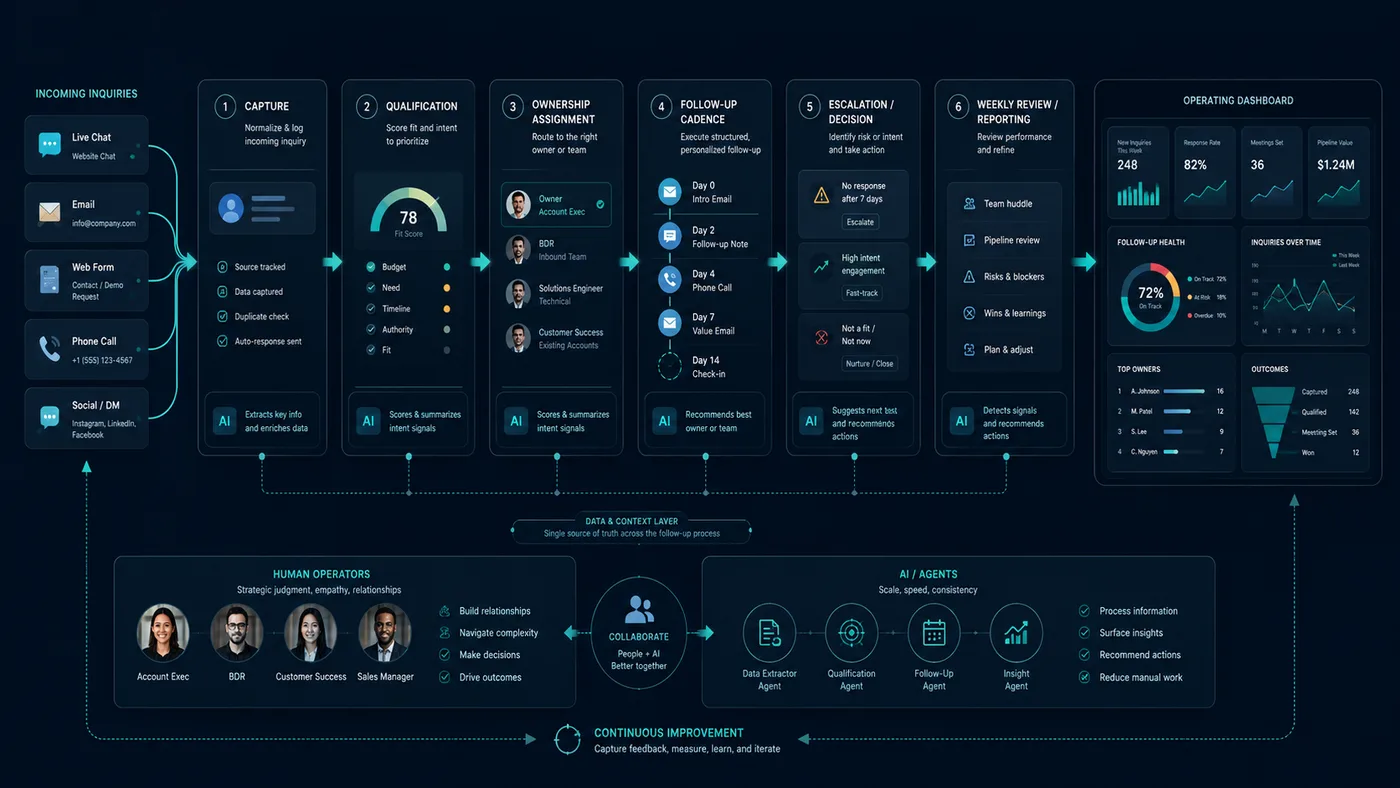
A follow-up system has six layers.
1. Intake
Where does the lead enter?
Website form. WhatsApp. Instagram DM. Email. Referral. Marketplace. Phone call. Event list. Spreadsheet import.
The first job is not automation.
The first job is capture.
Every lead needs to land somewhere the business can see it. If some leads enter the CRM and others live only in private chats, the system has already failed.
Intake should capture:
- name;
- company or context;
- source;
- channel;
- contact details;
- message or request;
- timestamp;
- owner if known;
- consent or communication limits if relevant.
Do not overcomplicate this at the start.
The first version needs visibility more than elegance.
2. Qualification
Not every lead deserves the same follow-up.
The system needs a rule for what matters.
That rule can be simple:
- Is this the right type of customer?
- Is there a clear problem?
- Is there budget or urgency?
- Is there a next step worth taking?
- Is this spam, support, partnership, hiring, or something else?
An agent can help classify the lead.
But the company defines the categories.
If the team cannot explain what makes a lead worth pursuing, the agent will only automate confusion.
3. Ownership
This is where many companies break.
A lead without an owner is already dying.
Ownership should be explicit:
- Who is responsible for the next action?
- Who covers if that person is unavailable?
- Who can reassign?
- Who gets alerted when the lead is stuck?
- Who reviews dead opportunities?
Do not confuse visibility with ownership.
“Everyone can see it” usually means nobody owns it.
4. Cadence
Follow-up is not “remember to check later.”
It is a designed rhythm.
Example:
- Immediate response when lead enters.
- Human review within business hours.
- First follow-up after 24 hours if no reply.
- Second follow-up after 3 days.
- Final follow-up after 7 days.
- Move to nurture or lost with reason.
The cadence depends on the business. A clinic, an ecommerce store, a B2B service firm, and a real estate office should not use the same rhythm.
But they all need one.
A weak cadence creates anxiety.
A clear cadence creates trust.
5. Context
Follow-up without context sounds robotic.
The system should know:
- what the lead asked;
- which product, service, property, appointment, or offer is relevant;
- previous messages;
- objections;
- quote status;
- promised deadlines;
- documents sent;
- internal notes;
- next action;
- human approval requirements.
This is where AI becomes useful.
It can summarize the thread. It can draft a reply. It can detect missing information. It can suggest the next message. It can classify objections. It can update the CRM.
But it needs context that is current and structured enough to trust.
6. Review
A follow-up system is incomplete without a review ritual.
Every week, the company should be able to answer:
- How many leads came in?
- How many got a first response?
- How fast?
- How many are waiting for the customer?
- How many are waiting for us?
- How many have no next action?
- Which opportunities are stuck?
- Which sources produced qualified leads?
- Which objections repeated?
- Which owner is overloaded?
- Which stage leaks the most?
Without review, the system becomes a prettier pipe.
The point is not to automate follow-up forever.
The point is to improve the sales loop.
What the architecture can look like
A practical first version might look like this:
Lead source
  ↓
Intake capture
  ↓
Qualification rule
  ↓
Owner assignment
  ↓
CRM / source of truth
  ↓
Follow-up cadence
  ↓
Agent-assisted drafts + reminders
  ↓
Human approval where needed
  ↓
Weekly review
The tools can change.
The logic matters more.
Maybe intake comes from WhatsApp and a website form. Maybe the CRM is HubSpot. Maybe the first version uses Google Sheets. Maybe n8n coordinates the workflow. Maybe an agent drafts messages but does not send. Maybe Slack or Telegram notifies the owner. Maybe weekly review is a Markdown report.
That is implementation detail.
The system has to preserve the loop:
capture → qualify → assign → follow up → review → improve.
What agents should and should not do
Agents are useful inside this system, but they need lanes.
Good first jobs:
- classify inbound leads;
- extract contact details;
- detect missing information;
- summarize conversation history;
- draft follow-up messages;
- identify stale opportunities;
- prepare weekly reports;
- suggest next actions;
- flag unclear ownership;
- detect repeated objections.
Riskier jobs:
- sending messages without approval;
- changing deal status permanently;
- marking leads as lost;
- making pricing promises;
- offering discounts;
- handling angry customers;
- interpreting legal or financial commitments.
The goal is not maximum autonomy.
The goal is reliable movement.
Start with agent-assisted operation. Add autonomy only where the failure modes are understood.
What to measure
Do not measure “number of automations.”
That number is almost useless.
Measure the business behavior:
- response time;
- percentage of leads with owner assigned;
- percentage of leads with next action;
- follow-up completion rate;
- stuck opportunities;
- conversion by source;
- lost reason distribution;
- quote-to-close time;
- no-response rate;
- revenue influenced by recovered opportunities.
The system exists to change those numbers.
If it does not, it is internal decoration.
The smallest useful version
The first version does not need to be complex.
A small company can start with:
- one intake form or WhatsApp capture;
- one CRM or spreadsheet as source of truth;
- one qualification rule;
- one owner per lead;
- one follow-up cadence;
- one reminder channel;
- one weekly report;
- one rule for when a human must decide.
That already beats the usual mess.
The mistake is trying to build the perfect sales machine before the company has a visible sales loop.
Visibility first.
Then reliability.
Then automation.
Then autonomy.
The real product
A follow-up system is not a CRM customization.
It is not a WhatsApp bot.
It is not a reminder workflow.
It is not an AI sales agent.
Those may be components.
The product is the business behavior:
No qualified opportunity dies silently.
That is what companies should pay for.
Everything else is plumbing.
Read next: Anatomy of an intake system · Bad automation vs. a good system.
I design and implement follow-up systems for companies where leads, quotes, messages, and next actions are scattered across tools and people. If qualified opportunities are disappearing in your operation, contact me.
You can also email me at nicolasdominici@outlook.com or DM me on LinkedIn.